A Better Way to Brainstorm With AI
- Sunit Gogia
- Jul 2
- 3 min read

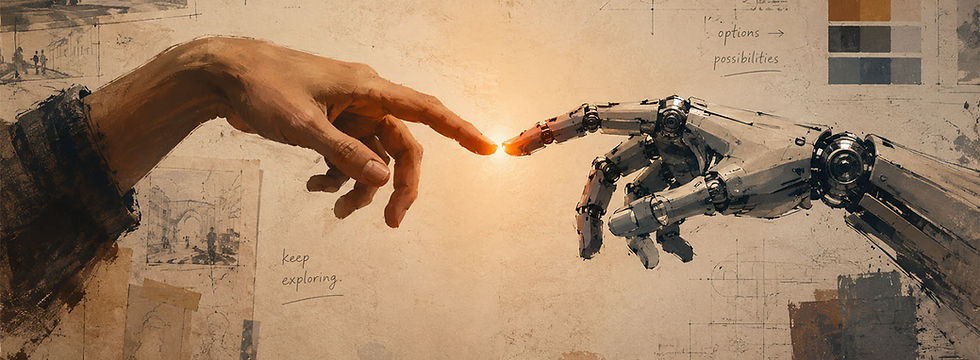
When people say AI isn't creative, I usually ask them one question.
How are you brainstorming with it?
For most people, the conversation goes something like this:
"Give me 20 YouTube ideas."
"Write a blog on..."
"Suggest a marketing campaign."
The responses aren't bad. They're often surprisingly good. But after a while, they start to feel familiar. You see the same structures, the same angles, the same language—just rearranged in different ways.
It's easy to conclude that AI simply isn't creative.
I don't think that's the problem.
I think we're asking it to do the wrong job.
Why So Many AI Ideas Feel the Same
A recent study from researchers at the Wharton School found something interesting. People using AI generally came up with higher-quality ideas than those working alone. But there was a catch—their ideas also became more similar to one another.
In other words, AI raises the average quality of brainstorming, but it can also pull everyone toward the same creative middle.
That doesn't mean AI limits creativity.
It means there's a better way to use it.
Stop Asking for Ideas
Most people treat AI like a vending machine.
Insert prompt.
Receive ideas.
Pick one.
Move on.
The problem is that brainstorming has never been about collecting ideas. It's about exploring possibilities.
The best creative breakthroughs rarely appear as the first answer. They emerge after questioning assumptions, following unexpected threads, and looking at a problem from angles you hadn't considered before.
That's where AI becomes genuinely useful—not as an idea generator, but as a thinking partner.
The Shift That Changed My Workflow
Over the past year, AI has become part of almost every project I work on, from history documentaries to visual storytelling and motion design.
What's surprising is that I almost never ask it for the final answer.
Instead, I ask it to challenge my thinking.
I'll dump pages of research into a conversation and ask what I've overlooked. I'll ask it to argue against my central idea, connect two unrelated concepts, or suggest perspectives that historians, filmmakers, or even critics might bring to the table.
Sometimes the responses are brilliant.
Sometimes they're completely off the mark.
Both are useful.
Even a bad answer forces me to think more clearly about why it doesn't work.
That's still progress.
My Brainstorming Framework
Over time, I've found myself following the same pattern again and again.
Start with your own thinking. Don't open ChatGPT with a blank page. Bring your research, observations, half-formed ideas, and questions into the conversation.
Ask for blind spots, not solutions. Instead of asking, "What's the best idea?" ask, "What am I missing?" or "What assumptions am I making?"
Challenge the obvious. Ask AI to disagree with you. Explore the opposite argument. Push an idea until it breaks.
Explore multiple directions. Don't search for the answer. Search for possibilities. The first idea is rarely the most interesting one.
Keep the conversation going. The most valuable insights often arrive twenty messages into a discussion, not in the first response.
The goal isn't to let AI think for you.
It's to think better because of the conversation you're having with it.
AI Is Better at Expanding Than Deciding
One thing AI does exceptionally well is expanding the creative landscape.
It can surface references you hadn't considered, suggest unexpected connections, or help you explore a dozen different directions in minutes.
But it can't decide which one deserves to exist.
That's still a human decision.
Taste, judgment, intuition, and lived experience don't disappear because AI entered the room. If anything, they've become even more important.
When generating ideas is cheap, choosing the right one becomes the real creative skill.
The Best Brainstorming Still Starts With You
The most valuable lesson AI has taught me isn't how to write better prompts.
It's that brainstorming was never about getting answers.
It was always about asking better questions.
If you treat AI like a machine that delivers finished ideas, you'll probably end up with ideas that look a lot like everyone else's.
But if you treat it like a collaborator—someone to question, challenge, debate, and explore with—it becomes something far more interesting.
Not a replacement for creativity.
A catalyst for it.
And in a world where anyone can generate ideas in seconds, the people who stand out won't be the ones with the smartest prompts.
They'll be the ones asking the most interesting questions.

Comments